Charging LiFePO4 Below Freezing: What Actually Goes Wrong
The lithium plating mechanism behind LiFePO4's cold-charging limit, how manufacturer cutoffs differ, and how lead-acid's very different freezing-point constraint compares.
Every LiFePO4 datasheet eventually says some version of “do not charge below freezing,” and every one of them buries the reason in fine print, if it states it at all. The reason matters, because it explains something that looks contradictory at first: the same battery that refuses to charge at 0 °C will happily discharge at -20 °C. Charging and discharging below freezing are not the same problem, and treating them as if they were leads to either unnecessary caution in one direction or real damage in the other.
Lead-acid has the opposite shape of problem in cold weather — no hard chemistry cutoff, but a state-of-charge-dependent freezing point that can destroy a battery physically rather than electrochemically. Both deserve a page of their own; this one covers the mechanism and the manufacturer spread for LiFePO4, then contrasts it with lead-acid’s different failure mode. For the full cutoff table across manufacturers, see our temperature limits reference page.
Charging and discharging are different problems
During discharge, lithium ions leave the graphite anode and travel to the cathode. During charge, they run the other direction — arriving at the anode and needing to insert themselves into the graphite’s layered structure, a process called intercalation. Intercalation is a chemical reaction with its own kinetics, and those kinetics slow down as temperature drops, more sharply than the rate at which ions physically arrive at the anode surface.
When ions arrive faster than the graphite can absorb them, they don’t just wait — they deposit on the anode surface as metallic lithium instead. That side reaction is the entire cold-charging problem, and it doesn’t have a discharge-direction equivalent, because discharge just removes lithium from the anode rather than depositing it there. This is why a LiFePO4 battery’s cold-weather charge limit is dramatically more conservative than its discharge limit, and why the two numbers on a spec sheet can look, at first glance, like they belong to different batteries.
The mechanism: lithium plating
Battle Born names this mechanism directly in its own educational material: charging in extreme cold causes lithium plating, in which metallic lithium deposits on the anode instead of intercalating into it. The consequence is twofold. First, it’s a permanent loss — plated lithium does not un-plate on a subsequent warm-weather cycle, so the capacity it represents is gone for the life of the battery. Second, and more seriously, repeated plating builds dendrites: needle-like metallic lithium structures that can grow enough to pierce the separator between the anode and cathode, creating an internal short circuit.
Victron’s documentation states the practical consequence — don’t charge below the stated minimum — without naming the underlying plating mechanism. We’re noting that distinction deliberately: Battle Born’s material is the one we can point to for the why, and it would be inaccurate to imply Victron’s own documentation makes the same mechanistic claim.
Manufacturer cutoffs vary more than you’d expect
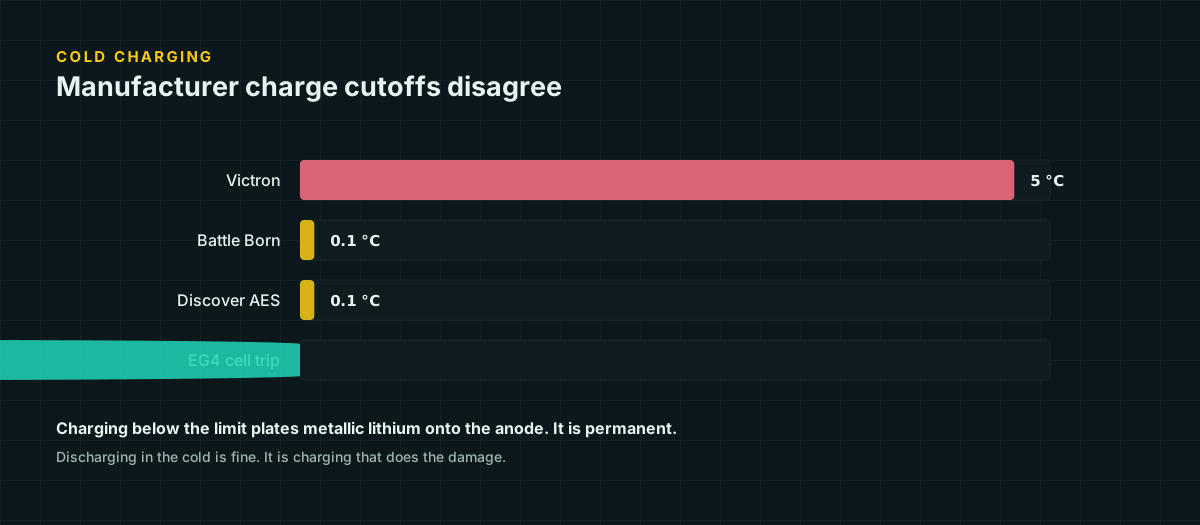
Four LiFePO4 manufacturers, four different numbers for essentially the same underlying chemistry:
| Manufacturer | Stated charge cutoff | Notes |
|---|---|---|
| Battle Born | 0 °C / 32 °F | The company’s own material is internally inconsistent — a heading elsewhere states 25 °F (-3.9 °C) for the same limit. |
| Victron | 5 °C / 41 °F (default) | The most conservative of the four; see warranty note below. |
| EG4 | 0 °C / 32 °F (advertised) | Field reports describe the BMS actually cutting off charge current closer to -5 °C (23 °F); EG4’s own published spec stops at 0 °C. |
| Discover AES | 0 °C / 32 °F | Manual documentation describes charging blocked below this point; some sources cite a roughly 2 °C recovery point before charging re-enables, which we were not able to independently confirm. |
The full sourced table, with everything above plus discharge ranges and the lead-acid comparison, is on our reference page. The takeaway here is simpler than the table: don’t assume your specific battery follows a round number just because LiFePO4 in general does. Check the datasheet for your model.
What “0 °C cutoff” really means in practice
A stated cutoff is the temperature at which the manufacturer says charging should stop — but “should stop” and “does stop” are decided by two different things: the manufacturer’s marketing copy, and the battery’s actual BMS firmware. EG4’s case is instructive. The company advertises 0 °C as the minimum charge temperature, which is the number you’ll see in specifications and marketing. Independent field and teardown reports describe the BMS’s actual low-temperature disconnect triggering closer to -5 °C — a five-degree gap between the advertised limit and the behavior some owners report.
We can’t confirm the -5 °C figure against EG4’s own published documentation, so we’re not presenting it as a verified specification. We’re flagging it because the gap between “advertised” and “actual BMS behavior” is a real category of confusion in this space, not because we want to hand you a number to design around instead of 0 °C. Design to the number the manufacturer publishes. Treat any lower trip point you hear about as a possible margin of safety, not as a design target — BMS firmware can and does change between production runs.
Warranty is not just a courtesy: Victron’s 5 °C threshold
Victron’s default charge temperature setting is 5 °C (41 °F), noticeably higher than the 0 °C several competitors advertise. This isn’t Victron being more cautious for no reason — it’s the number tied to the manufacturer’s warranty, and lowering it in the battery’s configuration is explicitly something that can affect warranty coverage.
The practical lesson generalizes past Victron: a charge cutoff is sometimes a physics limit and sometimes a liability limit set with margin above the physics limit, and a spec sheet rarely tells you which one you’re looking at. If your system will regularly sit near a manufacturer’s stated cutoff, that’s worth a support inquiry before you rely on the number, not after.
Self-heating batteries and heating pads
Several LiFePO4 manufacturers, including Battle Born, sell “heated” variants that add an internal heating element and a small amount of control electronics to the battery itself. The heater activates automatically once the cell temperature drops into a low range, warms the cells above the charge cutoff before allowing charge current through, and then disengages once the pack is warm enough. Some designs draw the heating energy from the battery’s own stored charge; others prioritize it from incoming charge current before that current reaches the cells.
This is a genuinely useful feature for a battery that lives somewhere unconditioned and needs to accept charge on cold mornings, but the exact activation and cutoff thresholds are specific to each manufacturer’s model and revision — check the datasheet for the battery you’re buying rather than assuming a round number. An external heating pad wrapped around a standard (non-heated) battery and driven by its own thermostat is a lower-cost variation on the same idea, with the tradeoff that it needs its own separate power source and wiring rather than being integrated into the battery’s management system.
Lead-acid’s different constraint: electrolyte freezing, not a chemistry wall
Lead-acid doesn’t have a charge-cutoff temperature in the same sense LiFePO4 does — there’s no equivalent intercalation reaction to stall out. Its cold-weather constraint is physical: the electrolyte itself can freeze, and whether it does depends on its concentration, which changes with state of charge.
A fully charged battery has a strong sulfuric acid concentration (specific gravity around 1.280) and a very low freezing point. A discharged battery has weak, mostly-water electrolyte (specific gravity closer to 1.100) with a freezing point barely below freshwater’s. Trojan’s published figures:
| State of charge | Specific gravity | Electrolyte freezes at |
|---|---|---|
| Fully charged | 1.280 | -68.9 °C (-92 °F) |
| Nearly discharged | 1.100 | -7.2 °C (18.9 °F) |
That’s a roughly 60 °C swing in freezing point depending on state of charge alone. The practical rule this produces is different from LiFePO4’s: never charge an already-frozen lead-acid battery, and never let one sit discharged in a cold climate, because a discharged battery in a modest freeze can crack its case as the electrolyte expands. There’s no “wait for it to warm up to 5 °C” cutoff to follow — the number that matters is state of charge, not ambient temperature on its own.
Temperature-compensated charging for lead-acid
Because a lead-acid battery’s chemistry runs slower in the cold, the voltage needed to properly complete a charge cycle rises as temperature falls — the opposite direction from what intuition might suggest. Trojan publishes a compensation coefficient of -5 mV per cell per °C, relative to a 25 °C (77 °F) reference.
For a 12 V (6-cell) flooded battery with a representative absorption target of roughly 14.4 V at 25 °C, charging at -10 °C requires:
ΔV per cell = -0.005 V/°C × (T_actual - 25°C)
            = -0.005 × (-10 - 25)
            = -0.005 × (-35)
            = +0.175 V/cell

Total ΔV (6 cells) = 0.175 × 6 = 1.05 V

Target voltage at -10 °C = 14.4 V + 1.05 V = 15.45 V
A charge controller that doesn’t compensate for temperature and simply holds 14.4 V year-round will systematically undercharge a lead-acid bank every winter — which, per the electrolyte table above, is exactly the condition that raises its freezing point and (per our bank sizing page) accelerates sulfation. Most quality charge controllers include a temperature sensor and compensation curve for this reason; if yours doesn’t, and the battery lives somewhere its temperature swings meaningfully across seasons, that’s a real gap, not a minor one.
What to check before winter
For LiFePO4: confirm your specific model’s charge cutoff against its datasheet, not a general LiFePO4 assumption; check whether your BMS or charge controller actually enforces that cutoff (some controllers need to be told the limit explicitly); and if the battery lives somewhere it will regularly sit below its cutoff while the array is producing, budget for a heated variant or an enclosure with supplemental heat rather than hoping the BMS saves you.
For lead-acid: confirm your charge controller applies temperature compensation, and don’t leave a lead-acid battery sitting at a low state of charge into a hard freeze — the freezing-point-versus-SG relationship above is the mechanism that turns a discharged battery into a cracked one.
Sources and further reading
Figures on this page are traceable to the published documents below. Where a standard is referenced, check the edition your local jurisdiction has adopted before relying on it.
- Understanding Temperature Limits of LiFePO4 BatteriesBattle Born BatteriesSource for the lithium plating mechanism and Battle Born's charge cutoff, which the document itself states inconsistently (32 °F in body text, 25 °F in a heading).
- BB10012 100Ah 12V LiFePO4 deep cycle battery — specificationsBattle Born BatteriesSource for the -20 to 60 °C discharge range.
- 12.8 & 25.6 Volt Lithium Iron Phosphate Batteries Smart — datasheetVictron EnergySource for Victron's 5 °C default charge temperature setting.
- EG4 LifePower4 48V 100Ah lithium iron phosphate batteryEG4 ElectronicsSource for the advertised 0 °C minimum charge temperature only; the lower BMS trip point discussed in this article is drawn from field reports, not this page.
- AES LiFePO4 Solar Stationary Battery — Operating ManualDiscover BatterySource for the 0 °C charge block; we could not independently confirm the exact recovery temperature in this document due to PDF text-extraction limits.
- Trojan User's GuideTrojan Battery CompanySource for the specific-gravity freezing-point figures and the -5 mV/cell/°C temperature-compensation coefficient.