MPPT vs PWM Charge Controllers: When the Extra Cost Pays for Itself
What PWM and MPPT controllers actually do to panel voltage, when the price gap between them is worth paying, and when MPPT stops being optional.
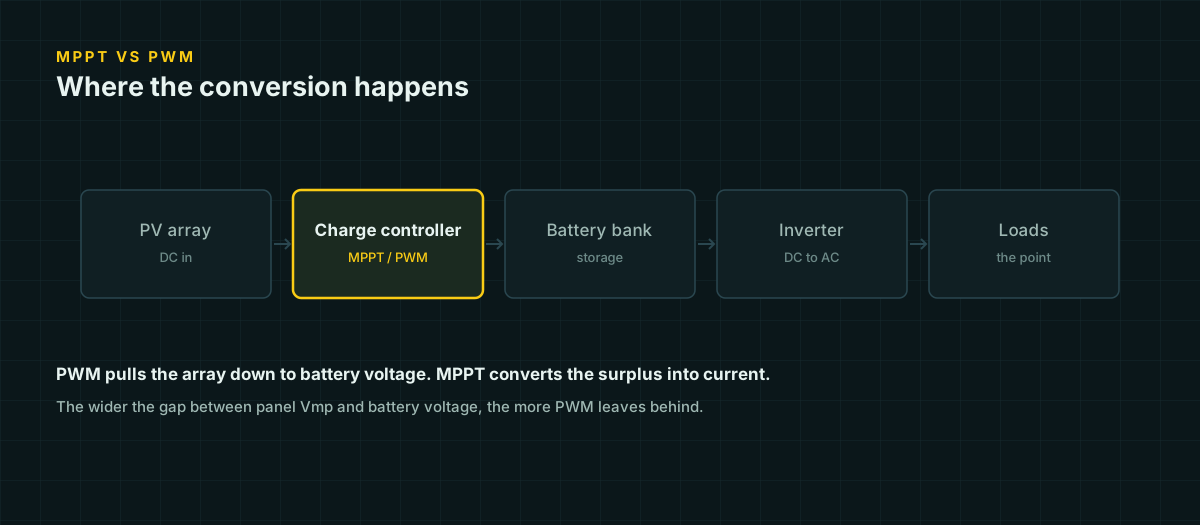
Both controller types do the same job — get power from a solar array into a battery without overcharging it — and both have been doing it for decades. The difference is entirely in how they move that power, and that difference is the whole reason one costs three times the other. This isn’t a “which brand is better” question. It’s a question about what happens electrically at the panel terminals, and once that’s clear, choosing between them is closer to arithmetic than opinion.
What PWM actually does
A pulse-width-modulated (PWM) controller is, electrically, a switch. It connects the array almost directly to the battery, which forces the array’s operating voltage down to whatever the battery happens to be sitting at. Morningstar’s own technical description puts it plainly: with PWM, “the array output voltage is ‘pulled down’ to the battery voltage.” As the battery approaches full charge, the controller pulses that connection on and off faster or slower to taper the charge current — the “pulse width” the name refers to.
The problem is what gets left on the table. A solar module’s peak power doesn’t happen at battery voltage; it happens at its maximum-power voltage, Vmp, which is typically several volts above a 12 V battery’s operating range. Every volt of gap between Vmp and battery voltage is potential power that PWM cannot capture, because it never lets the panel operate anywhere near Vmp in the first place.
What MPPT actually does
A maximum-power-point-tracking (MPPT) controller decouples the array side from the battery side. It lets the panel operate at its own optimal voltage — continuously hunting for whatever combination of voltage and current yields the most watts — and then converts that power down to battery voltage the way a DC-DC buck converter does, trading the excess voltage for extra current. Morningstar again: MPPT controllers “harvest power from the array at this Vmp voltage and converts it down to battery voltage, boosting charging current.”
This is also why MPPT tolerates configurations PWM cannot handle at all. Because the converter is doing real voltage conversion rather than just switching, an MPPT controller can accept a 36 V array feeding a 12 V battery. A PWM controller, tied to a near-1:1 voltage relationship, cannot.
A worked comparison
Take an illustrative 100 W, 12 V-nominal module: Voc = 22 V, Vmp = 18 V, Imp ≈ 5.56 A (so Vmp × Imp ≈ 100 W), Isc = 6.0 A. Charging a 12 V battery bank sitting at a 14.4 V absorption voltage — a typical setpoint within the 14.2-14.9 V range published for AGM batteries.
PWM. The controller forces the panel to operate at 14.4 V. Because 14.4 V sits well below Vmp (18 V), the panel is still on the flat, current-limited part of its I-V curve, so the current there is close to Isc rather than dropping toward zero — a standard simplification for this kind of comparison, not an exact circuit model.
P_PWM ≈ V_battery × I_sc = 14.4 V × 6.0 A = 86.4 WMPPT. The controller operates the panel at Vmp and converts the power down.
P_MPPT ≈ Vmp × Imp = 18 V × 5.56 A ≈ 100 W(Real MPPT converters lose a few percent to their own DC-DC conversion, which trims this slightly — that loss is separate from what this comparison is illustrating.)
Difference = (100 − 86.4) / 100 × 100 ≈ 13.6% less power from PWM
           = 100 / 86.4 ≈ MPPT delivers about 16% more than PWM here
That result sits comfortably inside the 5-to-30-percent range Morningstar publishes for the real-world advantage, and toward the lower end of it — appropriate, since this example uses a fairly modest 3.6 V gap between Vmp and battery voltage. Morningstar also states that “it is generally accepted that even the most basic MPPT controller will provide an additional 10-15% of charging capability” compared to PWM, which this worked number lands just inside of.
Why the advantage grows with the voltage gap
Nothing about the arithmetic above is specific to 18 V panels. The PWM shortfall is fundamentally the wasted gap between Vmp and battery voltage, multiplied by current. Widen that gap and the loss grows with it.
Cold weather widens it automatically. A module’s whole I-V curve shifts toward higher voltage as cell temperature drops — Voc rises predictably by a known temperature coefficient, and Vmp shifts upward with it, while the battery’s absorption voltage doesn’t move to follow. A PWM controller, still clamped to battery voltage, discards a bigger slice of a taller curve. This is exactly why Morningstar notes the advantage “is most pronounced in cold climates where voltage differences between array and battery are greatest” — nothing about PWM’s operating principle changes in the cold, but the size of what it throws away does.
The other way to widen the gap is with the array itself: a higher-voltage string (see the next section) against a lower-voltage battery. Same mechanism, larger effect.
When PWM is the right call anyway
None of the above makes PWM a bad controller — it makes it a controller with a narrower use case. PWM is simplest and cheapest exactly where the Vmp-to-battery gap is naturally small: a genuinely 12 V-class panel on a 12 V battery, in a mild climate, on a small system where the few percent of lost harvest costs less than the price difference between controller types. A 20 W panel trickle-charging a small 12 V battery through a $15 PWM controller is not leaving meaningful money on the table; the same logic applied to a 400 W array is a different calculation entirely.
The crossover point is really a question of scale and voltage gap, not a fixed wattage threshold. As array size grows, the absolute watts lost to the PWM gap grow with it, and the MPPT controller’s added cost amortizes over more harvested energy.
When MPPT is mandatory, not optional
Two cases remove the choice entirely.
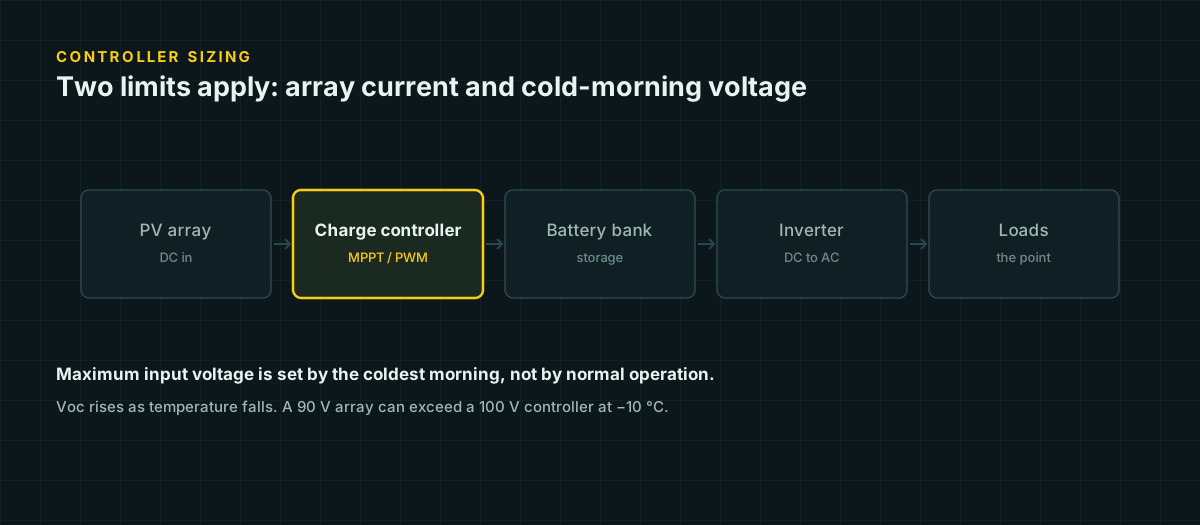
Cold climates with any meaningful voltage margin. If winter design temperatures push Voc and Vmp up substantially (see our charge controller sizing guide for the cold-Voc formula and a worked example), the summer-measured gap between Vmp and battery voltage is the smallest the array will ever show — winter mornings are worse, not better, for PWM’s losses.
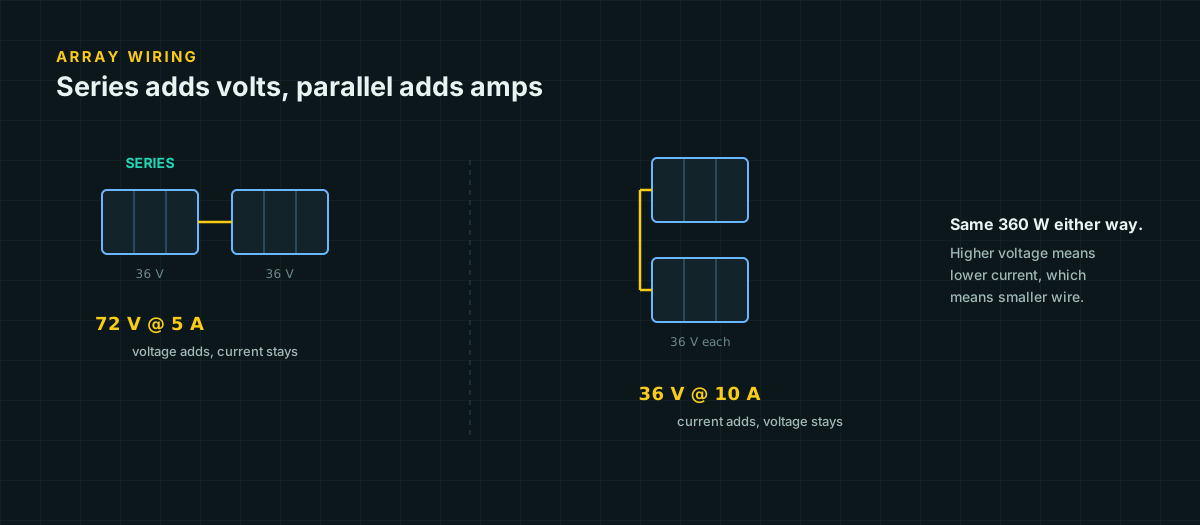
High-voltage strings. Wiring modules in series for a higher-voltage string — common practice to cut array current and therefore wire size, covered in our series versus parallel wiring guide — produces exactly the large Vmp-to-battery gap that makes PWM’s losses severe, and often produces a string voltage that PWM hardware cannot legally or physically accept at all. A 24 V-class or higher string feeding a 12 V or 24 V battery is an MPPT-only configuration; there’s no PWM version of that build to compare costs against.
The high-voltage-string case, quantified
It’s worth seeing why PWM isn’t merely inefficient in the high-voltage-string case, but actually unusable. Suppose two of the illustrative 100 W panels above are wired in series instead of parallel — a “24 V-class” string, Vmp ≈ 36 V, Voc ≈ 44 V, current unchanged at Imp ≈ 5.56 A since series wiring adds voltage, not current — feeding the same 12 V battery at 14.4 V absorption.
A PWM controller has no mechanism to convert 36 V down to 14.4 V; it can only pull the array voltage down to battery voltage directly, the same way it did with a single panel. If you could force that connection anyway, current would again sit near Isc (about 6.0 A, unchanged by series wiring):
P_PWM(hypothetical) ≈ 14.4 V × 6.0 A = 86.4 W
P_available = 2 × 100 W = 200 W
Harvested fraction ≈ 86.4 / 200 ≈ 43%
Fewer than half the available watts, and that’s the optimistic case — in practice, a PWM controller either isn’t rated for 36 V input at all or the mismatch produces worse behavior than this simplified model suggests. This is the concrete version of “MPPT is not optional here”: there is no PWM configuration to compare costs against, because pairing this string with a 12 V PWM controller isn’t a real option in the first place.
Cost, complexity, and what you’re paying for
The price gap is not marketing markup. A PWM controller is close to the simplest possible charge-control circuit — a switch and a control loop, no power-stage voltage conversion. An MPPT controller adds a DC-DC converter stage (typically a buck converter, stepping the higher array voltage down to battery voltage) plus the tracking algorithm that continuously hunts for the panel’s peak-power point as irradiance and temperature change through the day. More parts, more complexity, more that can generate heat and eventually fail — which is also why MPPT units tend to run larger and warmer than a PWM unit of similar current rating, and why their datasheets are worth reading for thermal derating at high ambient temperature.
None of that argues against buying one. It explains why the price difference exists, and why it isn’t worth paying on a build where the harvest gain it buys is small.
Running the numbers for your own panel
The comparison above only needs four numbers off a datasheet: Vmp, Imp, Isc, and your battery’s absorption voltage.
P_MPPT ≈ Vmp × Imp
P_PWM  ≈ V_battery × I_sc   (approximation, valid while V_battery < Vmp)
Advantage % = (P_MPPT − P_PWM) / P_MPPT × 100
If that percentage comes out small — a few percent — PWM is a defensible, cheaper choice. If it comes out in the double digits, or your string voltage exceeds your battery’s voltage class at all, the extra cost of MPPT is buying real, measurable energy, not just a nicer label on the box.
Deciding
| Situation | Likely choice |
|---|---|
| Single 12 V-nominal panel, 12 V battery, mild climate, small budget | PWM |
| Multiple panels, any series strings above nominal panel voltage class | MPPT |
| Cold-climate installation with winter as the design condition | MPPT |
| Array over roughly 200-300 W on a low-voltage battery | MPPT, harvest gain outweighs cost gap |
| Small trickle/maintenance charging application | PWM |
If you’re unsure which bucket a specific build falls into, run the same worked comparison above with your actual panel’s Vmp, Imp, Isc, and your battery’s real absorption voltage. It’s four numbers and two multiplications — cheaper than guessing, and cheaper than buying the wrong controller twice.
Sources and further reading
Figures on this page are traceable to the published documents below. Where a standard is referenced, check the edition your local jurisdiction has adopted before relying on it.
- What are the different types of solar charge controllers? (MPPT vs PWM)Morningstar CorporationSource for the operating-principle description and the quantified 5-30% and 10-15% harvest-advantage figures.
- Matching Victron Energy solar modules to the new MPPT charge regulatorsVictron EnergySource for the voltage-matching failure mode and the cold-weather Voc behavior referenced here.